
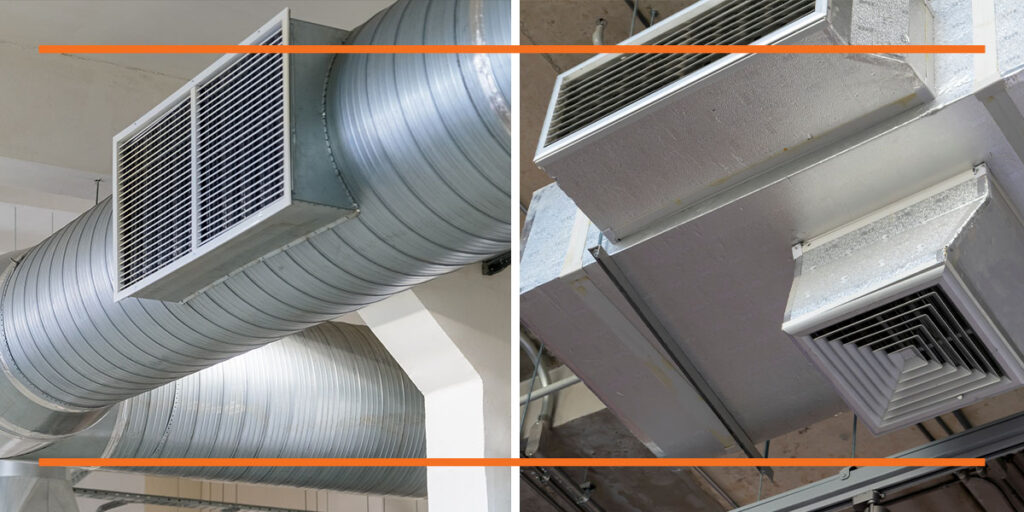
Spiral and rectangular ductwork deliver conditioned air in commercial HVAC systems, but they perform very differently on the jobsite. Contractors choosing between spiral and rectangular ductwork must account for more than airflow. Installation labor, ceiling clearance, sealing requirements and even the space’s acoustic environment all influence which system makes sense for a given project.
Commercial buildings rely heavily on HVAC systems, with space heating alone accounting for 32% of total energy consumption in U.S. commercial structures. Understanding commercial ductwork types and the practical differences between spiral and rectangular ducts helps contractors make the right call for each job.
Distinctions Between Spiral and Rectangular Ductwork
Spiral and rectangular ductwork systems differ in many ways, including fabrication, sealing and installation. These differences directly translate into performance, labor requirements and installation constraints for commercial projects.
Airflow Efficiency
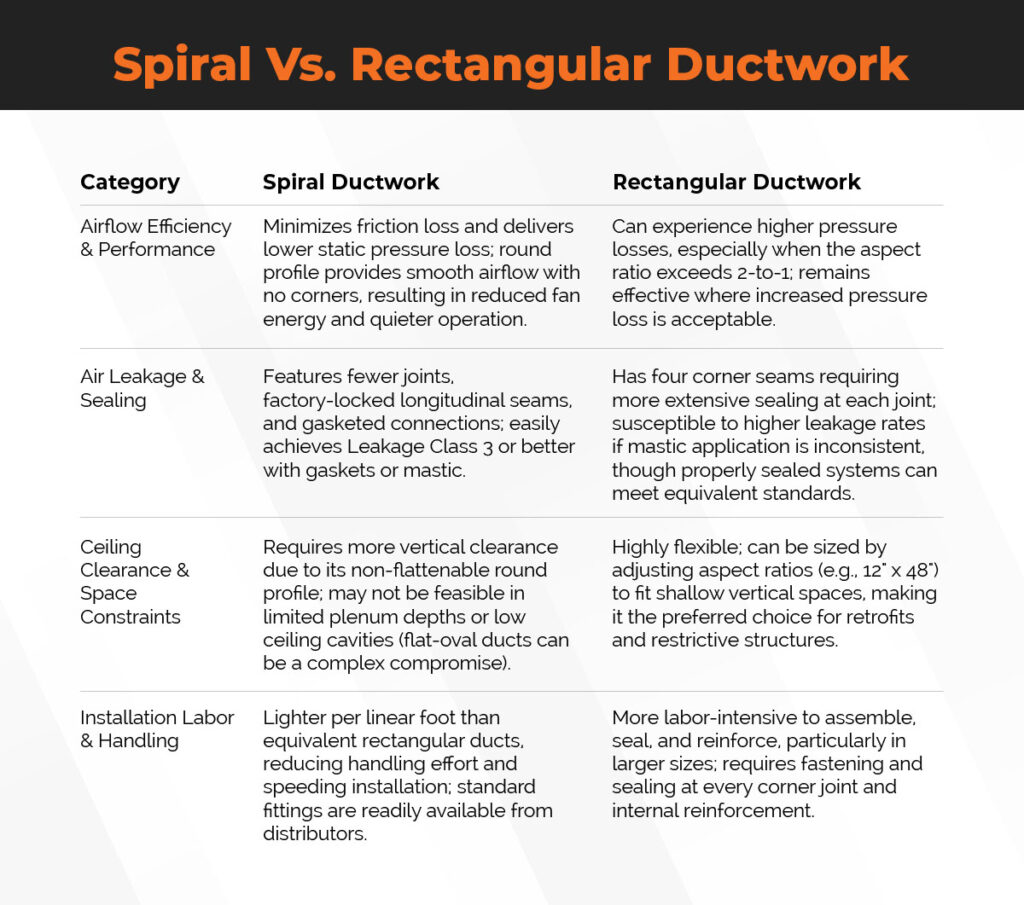
Round duct profiles minimize friction loss because air travels in a smooth, circular path with no corners to disrupt flow. Spiral ductwork typically delivers lower static pressure loss than rectangular equivalents in a given cross-section, translating to reduced fan energy and quieter operation in many installations.
Rectangular ductwork can experience higher pressure losses, particularly when the aspect ratio exceeds 2-to-1. Rectangular ducts remain effective in applications where the increased pressure loss is acceptable and factors such as space constraints take priority.
Air Leakage and Sealing
Spiral ductwork benefits from fewer joints and a factory-locked seam that runs the length of each section. Gasketed connections at fittings and joints further reduce leakage potential. Properly installed spiral duct systems can achieve Leakage Class 3 or better with gaskets or mastic applied at joints. Their round profile and continuous seam reduce the risk of air leakage compared to systems with multiple corner joints.
Rectangular ductwork has four corner seams and typically requires more extensive sealing at each joint. Systems with inconsistent mastic application can experience leakage rates exceeding design expectations. However, a properly sealed rectangular duct can meet the same leakage standards as spiral systems.
Ceiling Clearance and Space Constraints
Spiral ductwork requires more vertical clearance than a rectangular duct of equivalent capacity because it’s impossible to flatten its round profile to fit tight spaces. The additional height may not be feasible in buildings with limited plenum depth or low ceiling cavities. Designers sometimes specify flat-oval ducts as a compromise, though it introduces complexity in fitting selection and fabrication.
Experienced technicians can size rectangular ductwork to fit shallow ceiling spaces by adjusting the aspect ratio. For instance, a 12-inch-by-48-inch rectangular duct provides significant airflow capacity while occupying only 12 inches of vertical space. This flexibility makes the rectangular ducts the go-to choice in retrofit projects and buildings with restrictive structural constraints.
Installation Labor and Handling
Spiral ductwork is lighter per linear foot than rectangular ductwork of similar capacity, reducing handling effort and speeding installation. Fittings such as elbows and tees are readily available from distributors, thus shortening lead times.
Rectangular ductwork is more labor-intensive to assemble and seal, particularly in larger sizes. Each corner joint requires proper fastening and sealing, and internal reinforcement adds weight and complexity. Still, rectangular ducts integrate more easily into tight mechanical rooms and above-ceiling spaces where routing flexibility is critical.
When to Spec Spiral Ductwork
Spiral ducts are most effective on projects that prioritize efficiency, aesthetics and installation speed, making them a versatile choice across many commercial applications.
Understanding when to use spiral ductwork starts by analyzing the HVAC system’s performance demands. Spiral ducts perform exceptionally well in high-velocity applications because its smooth, round profile reduces friction loss. Lower resistance means reduced fan horsepower requirements and improved operating efficiency — advantages for projects pursuing LEED certification or other energy-performance standards.
Spiral ductwork exposed-ceiling designs are suitable for places where a clean, industrial appearance complements contemporary architecture, such as retail stores, restaurants and offices. Contractors can streamline installation and reduce cost by leaving the ductwork visible without additional finishing.
Project timelines are another factor. Spiral duct systems typically install faster than rectangular ductwork because they require fewer reinforcements and less sealing. Jobs with tight schedules, phased occupancy or accelerated build-outs benefit from this speed advantage.
When to Spec Rectangular Ductwork
Commercial rectangular ductwork installations remain a practical choice in many applications. The question of when to use rectangular ductwork over spiral often concerns space limitations or custom routing requirements. Buildings with shallow plenum depths, as seen in older construction or in buildings with heavy structural framing, often require a low-profile, rectangular design. In these cases, the ability to complete the installation offsets the added installation labor.
Skilled laborers can fabricate rectangular ductwork to exact dimensions and rout it through tight mechanical rooms with multiple turns and transitions. The ability to customize each section allows contractors to work around structural obstacles, plumbing risers and electrical conduits without extensive design changes. This flexibility is especially valuable in retrofit and tenant improvement projects.
Rectangular ductwork can also be more cost-effective on projects where material cost is a higher priority than installation speed. While spiral ducts offer labor savings, the material cost of rectangular ducts is often lower, particularly in regions with limited spiral fabrication capacity.
Practical Jobsite Considerations
Beyond the technical specifications, contractors must account for real-world factors that influence their choice of commercial HVAC ductwork.
- Lead times and availability: Regional distributors often keep spiral duct fittings and sections in stock, thus shortening procurement timelines. Rectangular ducts are typically fabricated-to-order products, which may extend lead times on complex projects.
- Hanger and support requirements: Spiral ductwork’s inherent rigidity allows installers to space hangers farther apart without risking sagging or deformation. Rectangular ducts need more frequent support to maintain their shape and prevent flexing, especially in larger sizes or with high aspect ratios.
- Acoustic performance: Round duct profiles tend to transmit less sound than rectangular ducts, making spiral ducts a better choice in noise-sensitive environments such as offices and healthcare facilities.
- Finish options for specialty environments: It is possible to finish spiral and rectangular ductwork with paint grip or powder coating for applications requiring corrosion resistance, clean room standards or specific aesthetic requirements. These finishes extend duct lifespan in harsh environments.
Frequently Asked Questions
Contractors often ask these questions when comparing duct systems for commercial projects.
Is Spiral Ductwork Suitable for All Commercial Applications?
Spiral ductwork works well in most commercial applications, but ceiling clearance limitations may rule it out in low-plenum installations. Contractors should verify available vertical space before specifying spiral systems.
Is Rectangular Ductwork Less Energy-Efficient Than Spiral?
Rectangular ductwork can be equally efficient when designed with appropriate aspect ratios and properly sealed joints. The energy penalty associated with rectangular ducts is most pronounced in systems with extreme aspect ratios or poor installation practices.
What About Insulation?
Spiral and rectangular ductwork are available with factory-applied insulation. Double-walled spiral ducts provide thermal and acoustic performance in a pre-insulated package, while you can get rectangular ducts fabricated with internal insulation or an external wrap, depending on your project specifications.

Get Expert Guidance on Commercial Ductwork Systems
Hennemuth Metal Fabricators has supplied contractors throughout the Pittsburgh region with precision-fabricated HVAC ductwork since 1954. Whether your project calls for custom spiral ductwork fabrication, rectangular duct system solutions or a combination, we provide the technical support and quick turnaround contractors need to keep projects moving.
Ready to make the call between spiral and rectangular? Submit your project drawings for a detailed quote, or contact our team at 724-693-9605 for material and finish recommendations tailored to your specs.