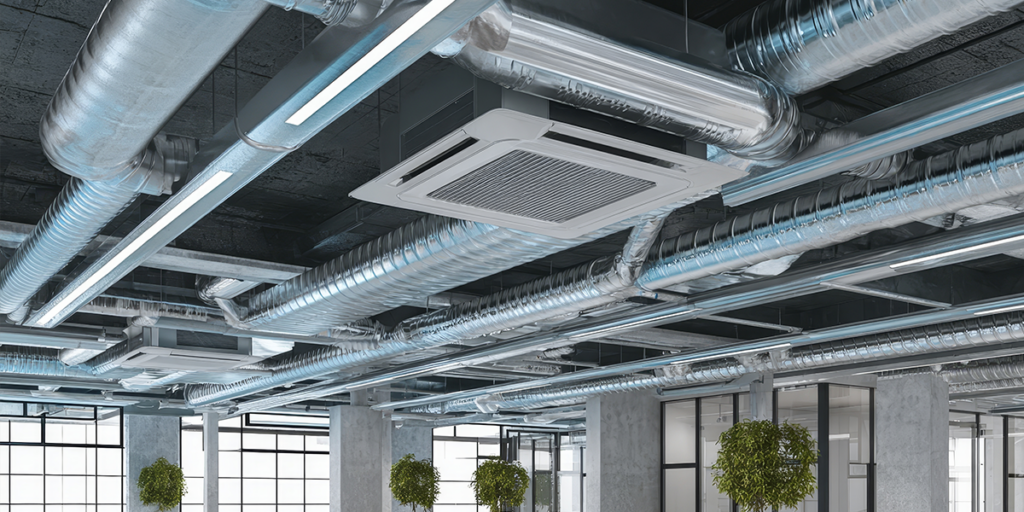
Industrial vs. Commercial Ductwork
Not all metal is created equal. Standard commercial ductwork often can’t withstand industrial conditions. High vibrations cause material fatigue. Abrasive particulates wear the duct surfaces down. Heat accelerates corrosion and negative pressure collapses sections that are too thin. The result could be premature leaks, deformation or failure.
This performance gap explains the sticker shock many managers experience when comparing industrial ductwork fabrication quotes to commercial-grade pricing. Heavy-gauge construction costs more up front, but under-specification leads to system failures, safety issues, costly downtime and emergency rework that far exceed the initial savings.
Material Gauge and Durability
When you compare industrial vs. commercial ductwork, the gauge determines how the system performs under pressure and vibration. Industrial ductwork must remain rigid and stable, as it directly affects worker safety and regulatory compliance. The heavier the gauge, the more rigid the duct.
Standard Commercial Gauge vs. Industrial Gauge Ductwork
Heavy-gauge ductwork standards from SMACNA establish minimum thickness requirements associated with static pressure, duct dimensions and reinforcement spacing.
Commercial HVAC ductwork is made from lighter-gauge sheet metal, ranging from 26 to 20 gauge and is designed for handling lower-pressure air. Light-gauge construction prioritizes fast fabrication and installation. It delivers reliable airflow but doesn’t provide the heavy structural reinforcement needed for harsh operating conditions.
Industrial HVAC systems often use 20, 18 or 16-gauge galvanized or stainless steel and sometimes a thicker plate to keep ductwork stable under continuous stress. Thicker metal maintains the duct’s shape and structural strength and keeps joints tight under pressure and vibration.
Why Thickness Matters Under Real-World Load
Industrial environments place ductwork under high static pressure and constant vibration. Thin metal fatigues over time at seams and corners, weakening the duct.
When the gauge is too light, the duct can flex under pressure, stressing joints and hangers. Choosing the right thickness ensures the duct remains rigid, preventing deformation and maintaining airflow efficiency. Proper gauge selection is important because it:
- Allows cleaner welds with less risk of burn-through on long seams.
- Holds shape better during forming and rolling, reducing rework.
- Provides a stiffer base for flanges and reinforcements to stay true.
- Tolerates handling, shipping and installation without warping.
The Pop Factor Under Negative Pressure
Negative pressure and pressure swings can push light-gauge ductwork past its capacity. As the walls flex in and out, the duct can “oil can,” creating the popping sounds crews call “duct breathing.” Even when it seems minor, repeated movement can shorten service life in demanding exhaust applications.
When the gauge is too light, negative pressure can trigger problems such as:
- Connection failure: Repeated flexing can loosen fasteners and joints over time, especially at transitions and elbows.
- Seal wear: Gaskets and sealants can degrade more quickly when the duct shifts under load.
- Seam fatigue: Cyclical movement concentrates stress along the seam lines, increasing the chance of long-term failure.
- System instability: Fluctuating suction can create inconsistent performance at pickup points and hoods.
Heavy-gauge ductwork minimizes wall movement, keeping the system stable, sealed and reliable under suction.
Why Larger Duct Sizes Need More Metal
In commercial and industrial HVAC systems, as duct sizes increase, so does the surface area. The larger the surface area, the more pressure it has to endure. Larger duct runs made from light-gauge material are more likely to deflect than smaller sections.
Material thickness increases as duct diameter grows to maintain rigidity and reduce deformation. When the ductwork matches the size and pressure demands of the application, the system runs quieter and holds up under harsh industrial conditions.
Construction Styles for Commercial and Industrial Air Ducts
In commercial applications, ductwork is built for consistent airflow in clean environments. Industrial systems require stronger joints and tighter sealing because the ductwork often carries heavier loads, harsher airflow and higher consequences if something goes wrong.
Lock-Seam Ductwork in Comfort-Cooling Systems
Lock-seam ductwork is a practical fabrication choice for clean-air, comfort-cooling systems that run at low to medium static pressure. Formed seams, such as snap-lock and Pittsburgh joints, provide reliable airflow without the added fabrication time and cost of fully welded construction. Lock-form construction supports reliable airflow when the system is sealed to standard commercial ductwork practices and operated within its design pressure range.
Lock-seam construction works because it:
- Reduces fabrication bottlenecks by running on standard lock-form and coil lines.
- Simplifies detailing because most layouts use catalog fittings and common joint patterns.
- Lowers rework risk when field dimensions change, since pieces can be cut back or extended.
- Fits easily into mixed systems that combine rectangular, spiral and flex duct.
Welded Ductwork for Exhaust and Process Systems
Welded ductwork is fabricated for harsher conditions, where the airstream is abrasive, corrosive, contaminated or operating at higher pressures. Continuous welds along seams and joints create a stronger shell that holds its shape. The welded shell also protects against leakage when the system is subjected to pressure cycling and mechanical vibration.
Fabricating in heavier gauges with fully welded seams provides engineers, facility managers and contractors with a robust option when failure has safety or production consequences.
Welded construction is ideal for industrial use as it:
- Requires qualified welders and weld procedures, raising fabrication standards.
- Enables the use of heavier plates and custom reinforcements in high-stress sections.
- Supports more rigorous inspection options such as visual weld review and pressure testing.
- Integrates well with flanged and bolted joints for modular installation and replacement.
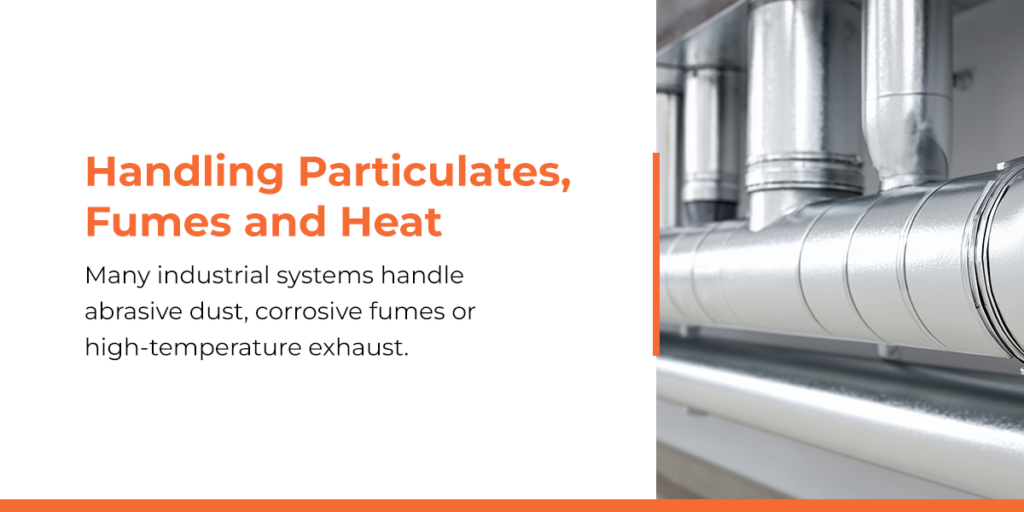
Handling Particulates, Fumes and Heat
Many industrial systems handle abrasive dust, corrosive fumes or high-temperature exhaust. These conditions can erode metal, stress seals and weaken containment if components are not matched to the duty. Material selection and seam type have to match the environment.
Commercial Air vs. Industrial Process Air
In commercial and industrial HVAC systems, ductwork design changes because industrial process air can introduce mechanical wear, chemical exposure and higher heat loads than standard comfort-air.
Industrial process air may contain:
- Abrasives: Dust, shavings and particulates that erode duct surfaces.
- Corrosives: Fumes, moisture and chemicals that degrade coatings and joints.
- Heat load: Temperatures that cause standard gaskets and sealants to break down.
- Containment needs: Air streams that must stay sealed for safety and compliance.
Velocity, Abrasion and Wear Points
Industrial systems often run at higher velocities to keep dust suspended and prevent buildup. But increased velocity accelerates wall erosion where airflow changes direction or becomes turbulent.
Common abrasion hot spots include:
- Elbows and offsets: Directional changes concentrate friction and impact.
- Transitions: Turbulence increases surface contact and wear.
- Branch takeoffs: Disturbed airflow creates localized erosion.
- Straight runs: Sustained velocity can thin coatings over time.
Fumes, Moisture and Corrosion Risk
Moisture, chemical vapor and condensation can degrade galvanized finishes and shorten the life of seam sealants. Corrosion often starts at seams and low points where condensate collects, increasing the risk of leaks and reducing capture performance over time.
Industrial ductwork addresses corrosion through:
- Corrosion-resistant alloys: Materials selected for chemical exposure and wash-down conditions.
- Continuous welds: Fewer join gaps where moisture can penetrate and start to break down.
- Condensate-aware layout: Sloped runs and drainage planning where moisture is expected.
- Serviceable access points: Cleanouts and doors that reseal after maintenance.
Heat Exposure and Temperature Limits
Heat can warp thinner metal and break down standard gaskets at joints, access doors and connection points. Industrial exhaust systems require components and connection methods that remain stable under sustained exposure to high temperatures, not just short spikes.
High-temperature ductwork requires:
- Thermal expansion planning: Joints and supports designed to handle metal growth without pulling seams or changing alignment.
- Heat-stable sealing strategy: Gaskets and sealants selected to resist hardening, shrinkage and blowout at sustained temperatures.
- Hot-spot reinforcement: Added rigidity at elbows, transitions and access points where heat stress concentrates.
The Role of Reliability in Production
When commercial HVAC fails, workers face stuffy offices and uncomfortable temperatures. Industrial ventilation failure often has more immediate consequences, such as stopping operations and breaching safety protocols. SMACNA industrial duct construction standards ensure proper gauge selection, seam integrity and reinforcement.
Hennemuth Metal Fabricators provides custom rectangular and spiral ducts, as well as fittings for industrial applications. Whether you need industrial duct fabrication or a heavy-duty exhaust system, we have the capabilities and expertise to meet your needs.
Contact us today at 724-693-9605 to discuss your ductwork needs or get a custom quote for your project.